
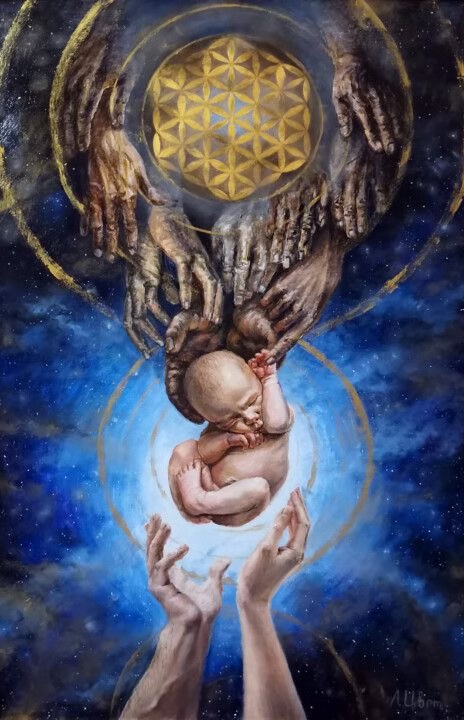
COEX Systems from an Attachment Standpoint

Art by Anastasiia Tsvetkova

Hypothesis: COEX Systems and Breaking the Compromised Template

The concept of COEX systems—short for “systems of condensed experience” (as coined by Stanislav Grof)—can be applied to understand how attachment injuries in both males and females create layers of experiential patterns that repeat across their lives. These COEX systems, formed by unresolved emotional and relational experiences in early development, govern behaviors, perceptions, and relational dynamics until the individual consciously works to break the compromised template.

Below is a hypothesis for how these COEX systems manifest and perpetuate in males and females distinctly from an attachment standpoint and how breaking these systems facilitates the individuation process.

The Formation of COEX Systems

For Females: The Matrical Void COEX System

• Core Experience: The absence of the “matrical gaze” creates a deep sense of disconnection from the self. This unmet need for unconditional validation forms the core emotional wound, or the first layer of the COEX system.

• Condensed Layers: Over time, subsequent experiences—such as rejection by peers, competition with other women, or invalidation in relationships—reinforce this core wound. These layers echo the original void, perpetuating patterns of mistrust and compromised self-worth.

• Repetition Mechanism: The COEX system drives behaviors and relational patterns where the INDIVIDUAL UNCONSCIOUSLY SEEKS TO RECREATE THE ORIGINAL WOUND, either by engaging in toxic relationships, mistrusting other women, or overcompensating through control and perfectionism.

For Males: The Enmeshed COEX System

• Core Experience: Early enmeshment with a maternal figure creates an unresolved attachment-conflict COEX. The male child is psychologically recruited to meet the mother’s unmet needs, resulting in a fractured sense of autonomy.

• Condensed Layers: Later experiences, such as relationships with demanding or emotionally unavailable partners, reinforce this dynamic. The male oscillates between the need for merging (seeking approval) and the desire for separation (fleeing perceived control), creating a cycle of inner conflict.

• Repetition Mechanism: This COEX system repeats in patterns of codependency, failed boundaries, and relational dysfunction. The male either externalizes his attachment injury (becoming domineering) or internalizes it (falling into self-destructive patterns).

How COEX Systems Perpetuate:

• Projection: Individuals project unresolved wounds onto relationships, recreating the dynamics of early attachment injuries.

• Reinforcement: Each failed relational or emotional pattern reinforces the original wound, deepening the layers of the COEX system.

• Avoidance of Discomfort: The individual unconsciously avoids the core pain of their template by externalizing blame or falling into familiar, albeit toxic, patterns.

Both male and female COEX systems create self-reinforcing cycles of relational dysfunction, emotional pain, and stunted individuation until a conscious effort is made to address and resolve the root experiences.

Breaking the COEX System: Individuation and Liberation

For Females: The Matrical Void

• Awareness of the Core Wound: The first step is recognizing the absence of the matricral gaze and how it manifests in toxic relational patterns.

• Facing the Void: This involves confronting the inner world – fear of abandonment, self-doubt, self-sabotage, control, manipulation, and the longing for validation.

• Integrating Fragmented Sense of Self: By reclaiming self-worth and developing deep connection and empathy for oneself, cultivating capacity to shift competition to collaboration and authenticity.

• Individuation Outcome: The female moves beyond her COEX system into a state of self-agency, where she can form healthy relationships, embrace her gifts, and trust her own inner compass.

For Males: Breaking the Enmeshment

• Awareness of Enmeshment: THE MALE MUST RECOGNIZE HIS “MOTHER CONTRACT” in the maternal dynamic and how this role has shaped his relationships and sense of self.

• Deliberate Separation: This involves symbolically and emotionally separating from the maternal shadow, breaking free from codependent patterns – involves rites or passages and ritualized separation processes.

• Integration of Masculine Autonomy: The male learns to balance his desire for merging with his need for independence. This involves cultivating emotional regulation, healthy boundaries, and a sense of self beyond relational dynamics.

• Individuation Outcome: The male emerges as an integrated individual, no longer torn between attachment and autonomy. He gains the freedom to form authentic relationships and live from a place of inner sovereignty.

When COEX Systems Interact: Toxic Relational Patterns

When unresolved COEX systems in males and females interact, they can create toxic relational entanglements.

• Female Matrical Void + Immasculated Male: The female’s mistrust and need for validation may trigger the male’s desire for merging or his tendency to dominate, perpetuating cycles of codependency or conflict.

• Externalized vs. Internalized Patterns: Type A males (externally destructive) may exploit the female’s wounds, reinforcing her mistrust. Type B males (internally destructive) may mirror her sense of inadequacy, deepening her relational despair.

Breaking these patterns requires both individuals to confront their COEX systems, enabling healthier dynamics rooted in mutual respect and self-awareness.

Toward a Collective Liberation

COEX systems do not just operate on an individual level; they also underpin societal structures, such as toxic patriarchy and wounded sisterhood dynamics.

Healing these systems requires individual and community-level work, creating spaces for both men and women to confront their core wounds, separate from their inherited templates, and rebuild healthier patterns – restoring balance within individuals and society by integrating both the nurturing feminine and the autonomous masculine energies.

Conclusion: Compromised template often perpetuate extremes—either clinging to or avoiding others. Healing involves integrating these polarities, allowing for authentic and secure relationships. Until individuals break free from their COEX systems (interwoven with early attachment ruptures reflecting fragmented and conflicting experiences—profound longing for connection coexisting with terror of vulnerability they remain trapped in the repetition of compromised templates, unable to fully individuate.

From an attachment standpoint, Coex systems encapsulate the emotional and relational imprints of early life, shaping how individuals relate to themselves and others. By addressing these systems through therapeutic processes within a healthy relational container allows for corrective emotional experiences and potentially transform entrenched attachment patterns and foster relational and self-awareness.

Invitation for Dialogue:

This is a work-in-progress hypothesis, one that will continue to evolve and expand over time. My hope is to inspire an open-minded discussions on transformative power of breaking old patterns.

Drop your thoughts, feedback, or questions in the comments. Let’s hold this space together and explore these ideas with curiosity, compassion, and the courage to reimagine what healing might look like.

Love and Courage

Dark Feminine Rising: A Physical Soldier That Will Serve Her for the Rest of Her Life

Tags

, , , , , , , , ,

The Impact of Attachment Injury in Males: Mother Contract – A Hypothesis in Progress

Art by Unknown

Attachment injury in males can often originate in the dynamic with a wounded or disconnected maternal figure. When the “matrical gaze” is absent, inconsistent, or tainted by the mother’s unresolved trauma, the male child becomes unconsciously enlisted as a soldier to serve the “dark feminine.” This archetype of the “dark feminine” arises from the mother’s unmet needs, resentment, betrayal, and unprocessed pain.

The male child is psychically burdened with the task of compensating for her emotional deficits, becoming an extension of her unmet desires rather than an autonomous being. This forms the psychological foundation for servitude to the maternal shadow, wherein the male is trapped in a lifelong struggle to meet the insatiable needs of the internalized maternal figure – toxic web of the Black Widow Spider, metaphorically speaking.

This role is not chosen but imposed, shaping the boy’s psyche to prioritize the mother’s emotional world at the cost of his own. The result is a loss of personal identity and boundaries, with the male internalizing his worth as conditional upon fulfilling the unspoken demands of the dark feminine within.

Compromised Neurobiological Processes In Utero in the Male Fetus

Research suggests that male fetuses are more vulnerable to environmental stressors in utero, particularly during critical periods of neurodevelopment. When the maternal environment is characterized by stress, trauma, or emotional instability, it can disrupt the male fetus’s developing neurobiological systems, including the hypothalamic-pituitary-adrenal (HPA) axis and the brain regions responsible for emotional regulation and attachment.

This disruption can leave male infants predisposed to:
• Heightened stress reactivity, making them more sensitive to emotional and relational stress.
• Underdeveloped emotional regulation, leading to difficulty processing and expressing emotions.
• Attachment insecurity, creating a foundation for enmeshment and codependency in later life.

This compromised neurobiological foundation predisposes the male child to reactive patterns in relationships and difficulty establishing a secure sense of self.

Males Struggling With Enmeshment: The Infernal Conflict Between Separation and Merging

As these males grow, the early attachment injury manifests as an unbearable inner conflict:
• The need for separation drives them to assert independence and autonomy.
• The desire for merging draws them back to the womb-like safety they experienced (or longed for) in their earliest moments.

This conflict is exacerbated by the codependent dynamic established in childhood. The boy becomes psychologically tethered to the mother’s unresolved needs, creating enmeshment that blurs the boundaries between self and other.

When life becomes unbearable for the codependent male—when the demands of independence feel overwhelming and the longing for the womb’s safety intensifies—he may regress into behaviors that attempt to resolve this conflict. These behaviors include:
• Subconscious attempts to recreate the womb in relationships, leading to dependency, control, or escapism.
• A pervasive sense of inadequacy and fear of abandonment, often masked by overcompensation or withdrawal.

Two Types of Male: Externally Destructive vs. Internally Destructive

This developmental injury often results in two distinct archetypes of maladaptive male behavior:

Type A: The Externally Destructive Toxic Male

• These men externalize their unresolved conflict through aggression, control, and dominance.
• They seek to overpower others to compensate for their inner vulnerability and unmet needs.
• Traits: toxic masculinity, violent tendencies, hyper-competitiveness, and an inability to engage in emotional intimacy.

Type B: The Internally Destructive Male

• These men turn their pain inward, struggling with self-loathing, withdrawal, and self-sabotage – internal violence.
• They experience chronic feelings of inadequacy and may engage in behaviors that reinforce their sense of worthlessness.
• Traits: depression, addiction, passivity, and a profound fear of confrontation or independence.

Both types represent attempts to cope with the same underlying psychological injury: a fractured attachment template and the unresolved need for both connection and autonomy.

Leading to Toxic Patriarchy

When these unresolved attachment injuries become systemic, they form the foundation of toxic patriarchy. Both archetypes of wounded males play a role in perpetuating this system:
• Type A males, driven by external domination, create hierarchical structures rooted in power, control, and suppression.
• Type B males, consumed by internal chaos, fail to challenge these systems, instead retreating into passivity or codependency.

Toxic patriarchy becomes a societal manifestation of the wounded masculine, where emotional disconnection, fear of vulnerability, and the need for dominance override collaboration, empathy, and balance. It reflects the collective failure to address and heal the attachment injuries that perpetuate cycles of harm, both at the personal and societal levels.

A Path Forward: Breaking the Cycle

To break this cycle, there must be a conscious effort to address the root causes of male attachment injury:
• Creating spaces for men to confront their internalized enmeshment and unmet needs without judgment.
• Developing tools to support emotional regulation, secure attachment, and individuation.
• Encouraging the integration of the wounded feminine and masculine within, restoring balance and empathy.

This presentation attempts to unravel the “existential crisis” drawing from the unconventional view of the “existential mother” principle that may offer a new perspective on the historical conflict in men and women over power dynamics leading to rise of the patriarchy and radical feminism in defence of women’s equality in modern times.

Within our current affairs, we now have countless forms of activism against patriarchy and criticism of women – countless forms of content and methodologies analysing archetypology of masculine and feminine.

Equally, new age spirituality trends attempt to address our ancient conflict by immersing in men’s work or sisterhood circles, yet, there’s an enormous elephant in the room – that elephant is the phenomenon of the “Existential Mother” as the fundamental principle in human life, at the center of birth, death, and the formation of the human blueprint.

By recognizing and addressing these attachment wounds, both men and women can work toward dismantling the foundations of toxic patriarchy and building systems rooted in equality, emotional wholeness, and authentic connection.

“The first thing we must understand in life is our mother – understanding our mother is the first step to understanding ourselves.”

Invitation for Dialogue:

This is a work-in-progress hypothesis, one that will continue to evolve and expand over time. My hope is to inspire an open-minded discussion about the nature of attachment, and the transformative power of breaking old patterns.

Drop your thoughts, feedback, or questions in the comments. Let’s hold this space together and explore these ideas with curiosity, compassion, and the courage to reimagine what healing might look like.

Love and Courage

The Impact of the “Matrical Gaze” on Female Development: A Hypothesis in Progress

Art by Unknown

When women lack the “matrical gaze”, they are deprived of a critical foundation for developing a healthy sense of self, safety, and security within themselves. This absence deeply impacts their self-worth, personal values, and self-acceptance, compromising the essential fundamentals required for healthy development and individuation.

But what is the “matrical gaze”? At its core, the term refers to the attuned, nurturing, and mirroring presence of a caregiver—often associated with the mother or maternal figure—who provides unconditional acknowledgment of the child’s existence, emotions, and needs. This gaze is not just physical but deeply psychological: it communicates, “I see you, and you are worthy of love just as you are.” It is the foundation for secure attachment, enabling the individual to internalize a sense of being seen, valued, and safe. When this gaze is absent, inconsistent, or distorted, the child is left in a void of unmet emotional needs, struggling to develop a cohesive and resilient sense of self.

The Consequences of a Lost Matrical Gaze:

When women grow up without this vital grounding, the lack can manifest in their interpersonal relationships in ways that reflect the inner fracture. Passive aggression, deep resentment, mistrust of other females, rivalry, competition, gossip, pretense, envy—these behaviors are all echoes of the unresolved pain of not being fully “seen” or acknowledged in their formative years.

At its most extreme, this lack can lead to active harm: tyrannical behavior, defiance, and overt aggression. It creates a split in the psyche, a profound inner conflict between the biological need for attachment and the equally powerful need for separation—both of which are essential for healthy psychological development. This unresolved tension leaves women struggling with empathy, not only for others but, more crucially, for themselves. Without self-empathy, the cycle of relational dysfunction and internal disconnection perpetuates.

Breaking the Cycle: Addressing Generational Attachment Wounds:

How do we work with and resolve such a deep attachment wound in females—one that continues to give birth to and pass down the same compromised template through generations? This is a critical question for psychoanalysis, trauma-informed therapy, and collective healing.

One emerging insight from the psychoactive induced psychoanalytic process suggests that contained and well-managed psychosis may hold the key. While this might seem controversial or even taboo in society, given the historical trauma associated with unmanaged psychosis and its potential for suffering, there is a radical opportunity here: what if we approached such episodes as an invitation?

Rather than viewing psychosis as a breakdown to be feared or suppressed, it can be reframed as a crack in the compromised template, a doorway into profound transformation. In this context, psychosis might represent a delayed “psychological separation,” a painful but necessary step toward individuation, liberation, and freedom—ultimately restoring self-agency.

The “Reset” Hypothesis:

What if we developed tools, understanding, and supportive environments to guide individuals through this reset? Such an approach could allow women and men, respectively to confront and heal the attachment wounds and relational fractures inherited from their maternal lineages. It could offer a way to disrupt the cycles of compromised templates passed down through generations.

The process would not be easy. It would require capacity, courage, compassion and competence—a willingness to step into the unknown, both as individuals and as a society. But the potential rewards—a restored sense of self, deep empathy, and the capacity to form healthier relationships—are profound.

Invitation for Dialogue:

This is a work-in-progress hypothesis, one that will continue to evolve and expand over time. My hope is to inspire an open-minded discussion about the nature of attachment, psychosis, and the transformative power of breaking old patterns.

Drop your thoughts, feedback, or questions in the comments. Let’s hold this space together and explore these ideas with curiosity, compassion, and the courage to reimagine what healing might look like.

Love and Courage

#metamorphosis #traumainformed #individuation #healing #psychosis #breakingopen #hypothesis #psychedelictheraphy #reset #todaysvibe #existentialmother #attachmentwound #toxicfemininity

Dark Feminine

Tags

, , , ,

Art by printyourdigitals

It is time to emerge from the underground closet in my effort to deeply study and research the dark feminine phenomenon, which has captivated humanity since the beginning of time.

Disclaimer: This topic requires a discerning approach as it can be uncomfortable and triggering for some people. This article aims to bring this unconscious phenomenon into the light so we can examine it together and find ways to discuss it with an open mind. It is not an attempt to blame or shame the feminine or make it a villain. Instead, it seeks to create space to explore this concept unconventionally and bravely.

Over the last two-plus years, with the aid of mind-opening psychedelic medicine, and an additional three-plus years with a Transactional Analyst Mentor, I have delved into a fascinating rabbit hole. Alongside many courageous and open-minded women and men, I have explored the unfolding of the dark feminine archetype in ways that transcend my comprehension.

This article will serve as the foundation and introduction to begin revealing the layers of the teachings learned from this process. For now, I’d like to share a few fundamental insights presented as inquiries to help make sense of this phenomenon:

– Could it be that the dysfunction of humanity is a manifestation of the unconscious dark feminine archetype operating in the shadows of our collective psyche?

– Is the dark feminine archetype a representation of the original split that led to the causality of contrast, serving the elevation of individual consciousness and thereby feeding into collective consciousness?

– How do we explore this phenomenon in the most neutral way to help us understand and explore our unconscious material and shadows?

– Could this phenomenon help us understand why we feel stuck, relationally dysfunctional, imposter, lacking connection, sick, depressed, deceived, and confused? Despite millions of modalities, tools, therapies, hacks, and tricks, why is self-development progress still as slow as a snail and sometimes pretentious or non-existent?

– Why is this topic important, and why should we bother with it? What kinds of resistances, biases, assumptions, and psychological defenses may block us from exploring it? What limitations may arise in the process? What are the pros and cons? Or should we abandon the exploration altogether and carry on with business as usual?

Each of these questions requires separate articles for a deep dive over time, so please stay tuned! For now, I’ll share a few insights that have been revealed about the consequences of the unintegrated, fragmented dark feminine archetype:

– The Mother Wound in women

– The Mother Contract in men

– The compromised self in humans, with deeply ingrained shadow material that affects the psyche, keeps people in survival mode, and leads to transactional and disconnected relationships with others, the self, and life.

Here’s a video of a female psychologist attempting to address the dark feminine. Please check it out:

The only criticism I have of the video content is the collective conditioning of blaming the “patriarchy” movement for the emergence of the dark feminine. In our exploration, the dark feminine is revealed as part of an existential phenomenon, not simply a result of male dominance. I’ll share more on this topic over time.

Thank you for engaging, and welcome aboard! I look forward to your participation in this exploration and discussion.

Much love ❤️

Share your thoughts in the comments 🫶🏻

God is a Borderline Patient

Art by Marshmallow Fairbanks

“This is I, the creator of all the ungovernable, ruthless forces of Nature which are not subject to any ethical laws.”

– Carl Jung (excerpt from the book, Answer To Job)

According to Jung, God is the mind of nature, endless infinite unconscious. And the Universe is the collective unconscious manifest of perception. All knowing, all loving God is challenged in the story of Job and Carl Jung proposed that God has a dark side and only through interactions with humans, God can become aware of it.

The mind of the Universe, archetypal consciousness move through us and it has been since the dawn of time. It’s a continuous stream of progressive consciousness. Jung claimed that he predicted Nazi rising in Germany through observation of his German patients. They had dreams in which the whole thing was anticipated with considerable detail in the years before Hitler. He predicted that something catastrophic was threatening Germany.

When the individual have a subjective idea or a thought, it affects the collective unconscious. Jung believed that inner psychic phenomenon was more important than anything else externally to understand the world. In the book of Job, the suffering inflicted on Job can be described as the moral of the injustice as part of the bigger plan that is not understood by reason. So Jung challenged the notion of injustice and attempts to answer to Job through God consciousness. Although God’s unfathomable masterplan for the Universe, Jung looks at the inconsistency of irrationality of God as a cataclysm, then the next moment he wants to be loved, honored, worshipped and praised as just. He reacts irritably to every word that has the faintest suggestion of criticism, while he himself does not care for his own moral code if his actions happens to run counter to its statutes, therefore this contradiction is the battle we see in the collective consciousness.

Particularly the early God Yahweh has all good, all bad thinking therefore God was a borderline patient according to Jung – It is a psychiatric problems, uncontrolled unconscious not mitigated, not regulated, wild depth of our human psyche expressed outwardly with so much splitting. What if it wasn’t a story about redemption of human sin but a story of redemption of God’s unconsciousness – in the inflicting of the suffering, the unconscious darkness is realised.

To conclude, if we embrace only the good in our own consciousness, the bad constellates and builds pressure that bursts outwardly. In the gospel of Job, he was so much into thinking of the good God and the loving God therefore in his unconscious the build up evil almost had a psychotic outburst into almost metaphoric apocalypse.

“We don’t want one sidedness, otherwise the other side becomes the shadow.”

To carry the ambiguity is the God consciousness, to be constantly open to self correction therefore the capacity for holding both the human and Divine, our finitude and our transcendence.

“If we only hold onto our finitude we fall pray to servitude and despair, if we only hold onto our transcendence, we fall prey to hubris and inflation but if we can hold the two together, if we are the metaxy between the Beast and the God we can realise our humanity.”

(Except from the dialogue between J. Peterson and John Vervaeke)

Love and Courage

Drop a comment, let me know your thoughts 👇🏻

Here are the resources inspired this content, check it out:

J. Peterson & John Vevaeke

Essentia Foundation – God’s Dark Side

Ultimate Wound is The Mother Wound

Tags

,

Art by Anna Lee

*Disclaimer: this blog attempts to shed light on the truth of coming to being as a precious life by the precious carrier we call “mom” — regardless of our connection dynamic with them, it’s our responsibility to see beyond our mother wound and realise that IT DID NOT START WITH THEM — our template is passed on for generations — womb to womb from the beginning of time, sooner we work together on our overdue “psychological separation” from the “mother template”, sooner we can experience liberation, freedom, autonomy.

“New evidence shows that human beings are constructed by their environment, not just their DNA. Our first and most significant environment is our mother’s womb. Our experiences in utero are carried into our adult lives. They influence our decisions — and the state of the world.”

Why wouldn’t we go back to the womb to start understanding life?

Life begins pre-birth, time before birth is what lays down the foundations of the development process that will form the scaffolding of our adult lives and our pre-birth environment is our mother’s environment. In utero, the emotional and nutritional environment becomes the primary basis of our developing bio-chemical trajectory, we are the receiver of the chemical concoction of the mother’s emotional states. Our genetic code is fined tuned by the environment that turns on/off to adapt — and not all adaptations are for the better, rather, selective to shift and alter in the embryogenesis stages.

The evolutionary perspective suggests that the early environment determines the capacity of the infant’s ability to self-regulate. In the context of history, increasing destruction of the family, tribe, community, and village leads to less connection, more isolation and loss of co-regulation that is furthering the emotional disconnection, psychological stability, robust internal capacity for self-regulation and compromises the inner navigation system. Emotional deprivation in early life fosters violence and aggression and in some cases leads to shut down impacting brain development.

A stressed mother/caregiver is not able to attune to the infant, and depressed mothers are not in synchrony which leads to pre-disposition to depression in the infant. Children that are emotionally inhibited will become dysfunctional and hostile and that starts in the womb. Every second of pre-natal life 50k neurons are being produced that are organised for healthy function or not — it’s the process of imprinting neuro-psychopathology or neuro-psychiatric disorders.

Life in utero is the process of the mother’s template getting passed onto the baby, a tiny life absorbing all of that without any way of knowing the mother’s struggles, and challenges, instead internalising it as the truth of their own story where early survival adaptations are imprinted because their life depends on it. Now we have a baby that has limitations and is going to protect those maladaptive wiring because those were set up very early for survival.

We don’t realise the depth of the early survival adaptations that become our added layers of the mother template — it is our hardware, indestructible design, impossible to crack open until coming to terms with the reality of it and start working incrementally to break open by revisiting the held pain and trauma to revive and rewire new neuro pathways that could potentially lead to psychological separation from the template.

The pre-verbal experiences are wired into the system, that’s why we cannot talk ourselves out of it. Until we are able to build internal capacity to go through our psychological separation from the imprint, nothing changes, nothing heals, nothing transforms.

One of the reasons why we have a multi-bullion self-help industry with an infinite supply of products, tools, modalities, and biohacking as well as an infinite supply of therapy modalities, and therapeutic tools that can only provide capacity building, not the solution.

What about the infinite supply of spiritual and esoteric materials? Let’s not even go there! All of it can only provide support in building capacity, and intellectual understanding — yet, most of the time perpetuates further problems.

The hard truth is, there’s no quick fix and solution, the only way out of the template is the process of psychological separation that can lead to liberation.

Love and Courage

Check out In Utero documentary to learn more about the early stages of development:

https://www.inuterofilm.com/instant_access_rent

Another great documentary to learn about the early stages of development is Dr Stan Grof’s “Cartography of the Psyche” depicted in The Way of the Psychonaut – available to watch on Youtube.

~ get in touch to learn more about the “psychological separation process”

There is No Master Plan of Escape

Art by Laurent Glass

Surrender is imminent but what are we surrendering to? Let us come back to this overly used term in healing, Spiritual and Psychedelic Medicines circles.

The holy grail of healing is NOT ego dissolution — I am going to keep this concept out of the conversation because I feel that it has no place in any form of self-improvement processes as promoted widely among healing trends. The holy grail of healing is NOT enlightenment either — it is “endarkment” (etymology credit — Reda Rackley). We cling to the idea of love and light and a deep desire to transcend the human limitation of physical reality, desperately seeking shortcuts, desperately trying to intellectualise the process, desperately trying to escape the “body” because we are desperately wanting to escape the pain and the suffering of being in a human body (understandably) yet, continually crashing down into deeper suffering. The holy grail of healing is endarkment, and endarkment is the process of returning to the body — our home.

The breaking of the illusion to enter into a higher order of consciousness is a process of reconnecting to the body — as we reconnect to the body we also return to the mundane, the mundane is where we are rooted and safe. We return to the wisdom, tap into the integrity of the body and begin to cultivate deeper self-awareness, appreciation, humility, compassion, strengthened intuition, clairvoyance, self-agency, and autonomy. We begin to experience life through the lens of alignment, and inner congruency and restore our relationship with ourselves — for me, this is an internal “surrender” that impacts the perceived outer world.

The breaking of the delusion depends on our understanding of our ability to inhibit our body, it depends on letting go of the romantic fantasies of healing, rapid transformation, and overnight change. There’s no such a thing as healing to begin with as the way we imagine it but by becoming aware of our internal world and re-learning to tap into our raw, primal non-linguistic intelligence that carries the potential to override environmental conditioning, trauma responses, compulsions, adaptations and dysfunctional behaviours. We cannot be naive in times like this, we need to become smarter and take ownership of what we are NOT willing to feel and accept.

“When you win the antagonist inside, you will no longer have to meet them outside. The antagonist will disappear from your world. Only then you will be able to survive and escape the surveillance of invisible guardians, vigilant snipers (antagonists) that you yourself have put in place and that you alone will be able to evade to enter roles of a higher order.”

~ Elio D’anna

The intellect is not our ally in transformational politics just because it’s very challenging to negotiate with such sophisticated survival surveillance systems we have built internally to survive in early life — we must get the body onboard. The capacity of the healthy nervous system is directly connected to the cognitive processes which means, when we become unshakeable within our nervous (body) system we are also unshakable within our thinking processes and resources will no longer come from the outside but directly from within.

To conclude, self-improvement is an inside job that requires surrender to our body, requires letting go of the intellectual constructs over time, slowly learning to trust our internal landscape as our home, and knowing that soma is the pathway to reconciliation and resolution that can offer closure to infinite layers of suffering, fear and lack.

It is also human to avoid the body as the ultimate manifestation of a highly sophisticated physical organism experiencing the phenomenon of being human. Dissociating from the body helps avoid pain but it is the pain that becomes our outlet, our opportunity to reconnect, paradoxically. It is the pain that moves us towards seeking in the first place, it’s meant to be our initiation — rites of passage not a process of annihilation.

And we get it, coming home to the body is not ideal for many of us because there is so much at stake! Hence why some of us take more psychedelic medicines to avoid coming home in case there are relationships at risk due to the result of years of investment in trauma entanglements, trauma bonds and codependency. The coming home process impacts relationships because we interact very differently when we operate from the inner congruency, it impacts the way we eat, the way we sleep, the way we work, the way we make money, the way we live, the way we hold space in the world, the way we raise our kids, the way we treat our parents — so much is at stake!

So let us begin the new year differently and turn to medicines to actually improve our lives not run away from them. Let us invest in kinship, accountability, community, openness, transparency, humility, vulnerability, radical acceptance and joy.

Happy New Year 💫

Love and Courage

#psychedelictheraphy #microdosing #somatichealing #newyear #reflections

Psychedelics Won’t Save The World

Art by Rafa Macías

Mistaken expectations of what psychedelics will do for us are on the rise, and since the Netflix series “How To Change Your Mind” hit the mainstream with indispensable force, confronting the very core of the issues in our current reality of absolute desperation to find relief and resolution to the heightened depression, anxiety, increase in addiction, auto-immune diseases, decreasing levels of mental health despite all the advances and the advantages of technology at our disposal.

The effectiveness of psychedelic medicines are directly proportional to the level of our inner capacity to access the unexamined, unresolved, unaware imprints that run our everyday waking consciousness.

Your lifetime of adaptations that kept you surviving are not going to disappear effortlessly with psychedelic use – it is going to require your full participation, commitment, accountability and patience internally as well as an eco-system to carry you forward externally whether it’s a trauma-informed therapeutic relationship with a facilitator or safe group container that allows room for transference – supporting the emergence of the relational wounding and takes you outside of your window of tolerance for a deep, authentic process of transformation.

And microdosing as the new frontier of the self-growth used in the context of group process carries the potential to transform our lives, relationships, families and communities.

Reset 6-week Group Microdosing integration program has been the ultimate antidote for bypassing authentic self-work since its inception nearly 2 years ago, accelerating inner growth with added therapeutic guidance, accountability and kinship to bring forth insights into the root causes of suffering and finally addressing some of the blocks that are standing in the way of living a congruent life.

Our next intake starts in September 💫

Join us 🔥

Link in bio for more info.

See you there ❤️

Holding It Together

Art by Dániel Taylor

The holidays may be challenging to cope with as it carries the most intense spirit of the year. It is a confrontational time that breaks us the most and can be painful for many. Also, we need to be super mindful of how it brings up a lot of suppressed trauma to the surface.

The slowness of this time of the year can also trigger self-worth issues due to a lack of productivity. Remember to observe your inner discomfort and breathe through it.

And avoid making big decisions; this is not a time of the year to make life-changing decisions. Observe your tendencies and do not act on them; just breathe through the notions of your impulses.

Be super conscious of your fragility around this time of the year and your attempts to distract yourself; it’s a call to reflection, introspection rather than action. It’s a call to be with whatever comes up and breathe with it.

Wishing you all a transformative new year with more humility, more courage, more resilience, more inner capacity, more breakthroughs, realisations, insights in this ever-unfolding soul journey to find more joy, healing, health, connection, kinship, community spirit and abundance.

Please keep trusting the process.

Happy new year!

Love and Courage 

#newyearreflections #breathe #rebirth

Issue Is In The Tissue

There’s a growing interest in the concept of “embodiment” as we are navigating through the limitations of the pandemic world that governs our wellbeing and sadly, there’s an information void in understanding what embodiment truly is.

According to Google, “Embodiment usually refers to how the body and its interactive processes such as perception through the senses, aid, enhance or interfere with the development of the human functioning.

Simply embodiment is “body awareness” forgotten critical human attribute since we are conditioned to orient ourselves in cognitive functionality and become heads on sticks. We are no longer in our bodies yet we exist in our bodies – our bodies intimately involved in how we are in the world, the space we take, the way we breathe, move, feel and relate is an embodiment.

There’s a higher intelligence that inhibits our bodies that are connected to our essence and conscious embodiment merges us to that higher order of intelligence within – wisdom beyond language that dissolves cognitively perpetuated control, limitations, righteousness, pride, impulse-driven defences, arrogance, expectations, entitlement.

The conscious embodiment opens up a whole new world of possibilities to self-healing, self-awareness, self-realisation, strong intuition – a clear understanding of our ways that impacts our reality, health and wellbeing.

In the Somatic Experiencing, a body-oriented approach in therapy founded by Dr Peter Levine – trusting the wisdom of the body and cultivating inner trust is the benchmark for healing and working with the body is indispensable to the foundation of the conscious embodiment.

As flow state researcher Steven Kotler says, after 25 years of studying neurobiology, there are no shortcuts, no hacks, tricks, getting your biology onboard is the key – biology scales. Often disturbingly uncomfortable to be in our bodies as we got good at escaping the body with endless distractions creating resistance to avoid bodily sensations.

So how do we become embodied?

It is not a simple process as dropping into our bodies may cause stress, anxiety and overwhelm since we learned to function neck above living in numb and disconnected states. Re-connecting with the body requires exploration of the practices such as breath-work, movement, fasting – and there are various types of somatic practices available for those who may need a safe container and support from an experienced facilitator initially.

And for those who are up for a deep-dive, microdosing psilocybin in the right context can accelerate the embodiment process. We now know that microdosing psilocybin potentially can help us discover the depths of our being, giving insights into the blocks that stand in the way of our desired reality, simple practical revelations to help release suppressed trauma, pain, anger, compulsive behaviour and repetitive patterns that have been keeping us stuck.

Microdosing psilocybin is the new frontier among the conscious embodiment tools, offering holistic wellness to strengthen self-agency and capacity to activate the inner healing intelligence, allowing space and flow to re-connect to the wisdom of the body and grounding for an enriching experience of feeling alive.

Much Love